What’s New in PG_BITEMPORAL?#
Hettie Dombrovskaya Braviant Holdings, Chicago Chad Slaughter Scale Genius, Inc.
Bitemporal data: making it happen in Postgres#
Incorporating time, thereby making the data models temporal, is a hot topic. Many systems are already providing this kind of support (DB2, Oracle) and it is included into the SQL ANSI 2011 standard. However, Postgres never formally included the time dimensions, and we are going to fix this
References – these are the last year’s, should be updated#
C.J. Date, Hugh Darwen, and Nikos Lorentzos. 2014. Time and Relational Theory, Second Edition: Temporal Databases in the Relational Model and SQL (2nd ed.). Morgan Kaufmann Publishers Inc., San Francisco, CA, USA. Tom Johnston. 2014. Bitemporal Data: Theory and Practice (1st ed.). Morgan Kaufmann Publishers Inc., San Francisco, CA, USA. Tom Johnston and Randall Weis. 2010. Managing Time in Relational Databases: How to Design, Update and Query Temporal Data. Morgan Kaufmann Publishers Inc., San Francisco, CA, USA. Krishna Kulkarni and Jan-Eike Michels. 2012. Temporal features in SQL:2011. SIGMOD Rec. 41, 3 (October 2012), 34-43. Richard Thomas Snodgrass. 1999. Developing Time-Oriented Database Applications in SQL. Morgan Kaufmann Publishers Inc., San Francisco, CA, USA. ISO/IEC 9075-2:2011, Information technology — Database languages — SQL , 2011
Overview: what we did so far#
The surveys (Kosman et al) indicate, that is should be easy to support time in Postgres due to the existence of the GIST indexes. And we’ve utilized this advantage.
Last year we presented the Postgres-based implementation of asserted versioning framework (Johnston and Weis). We implemented the Allen operations for the time intervals and all basic bitemporal operations
Where our work can be found#
pg_bitemporal git repo operations: create bitemporal table bitemporal insert bitemporal update bitemporal correction inactivate bitemporal delete support of bitemporal constraints
Overview of bitemporal operations#
The next several slides present the basic bitamporal data manipulation operations and explain the differences between bitemporal and conventional operations
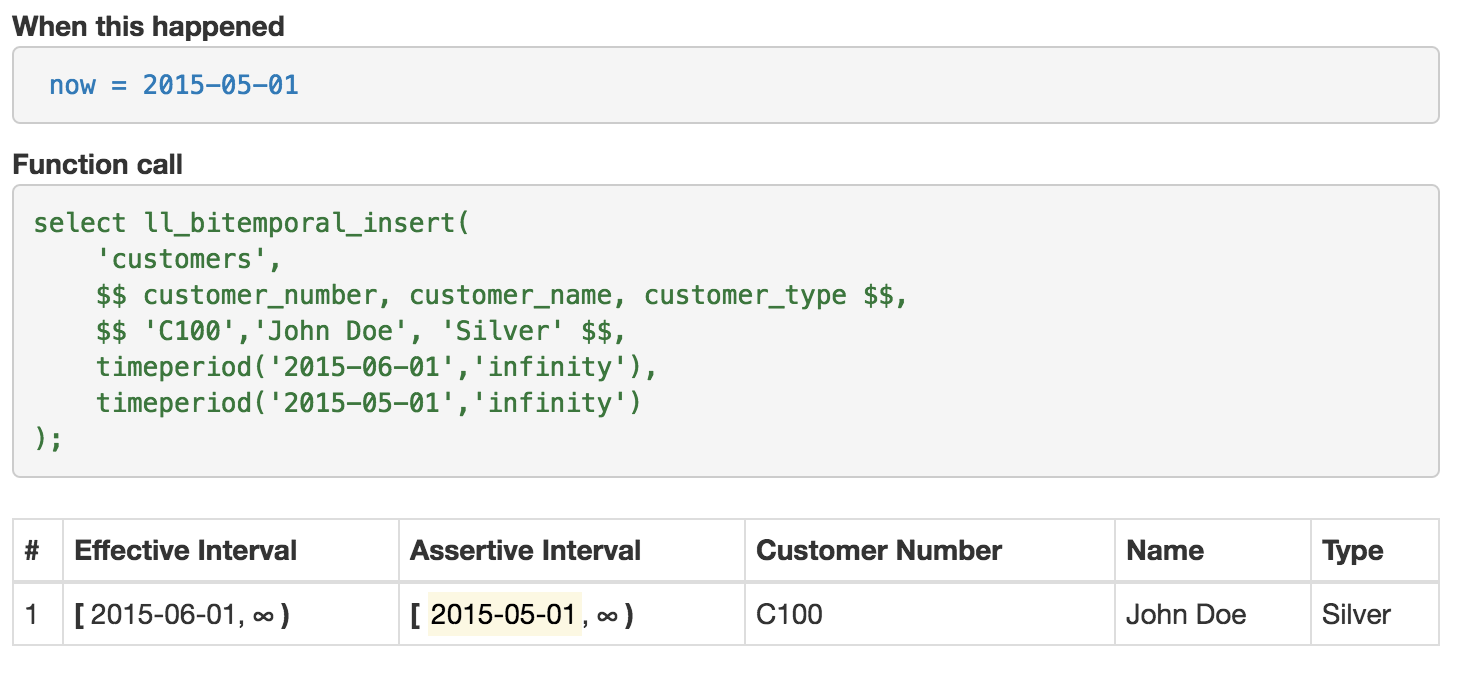
Bitemporal Insert#
now = 2015-05-01
# |
Effective Interval |
Assertive Interval |
Customer No. |
Name |
Type |
|---|---|---|---|---|---|
1 |
[2015-06-01, oo) |
[ 2015-05-01 , oo) |
Cl 00 |
John Doe |
Silver |
select ll_bitemporal_insert( |
|||||
‘customers’f |
|||||
, $\(’customer_no’, name', ’type' \)$, |
|||||
, $\('C100','John Doe', 'Silver' \)$, |
|||||
timeperiod(‘2015-06-01’,’infinity’), |
|||||
timeperiod(‘2015-05-01’,’infinity’) |
|||||
Effective |
|||||
Asserted |
1
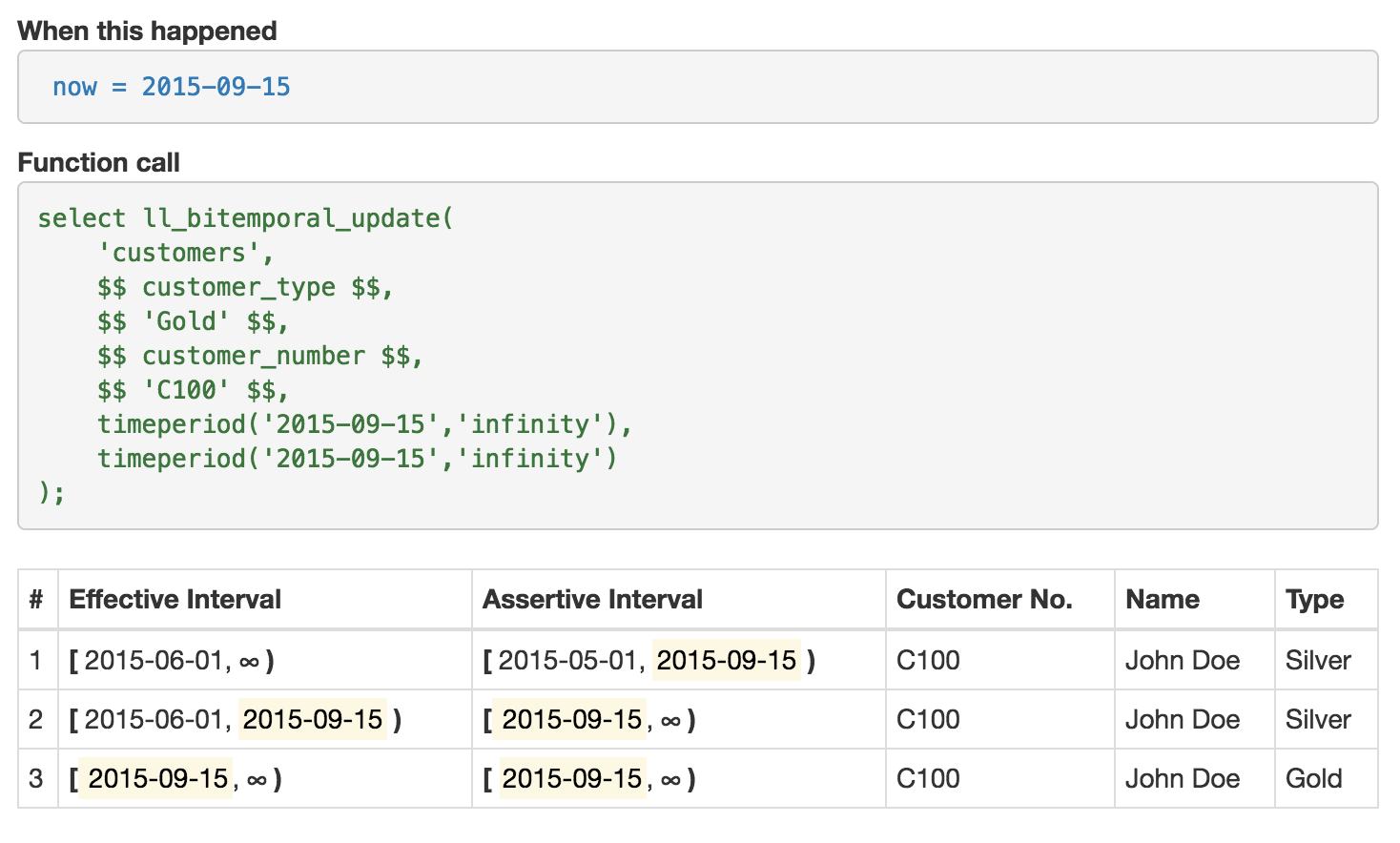
Bitemporal Update#
now()=‘2015-09-15’
# |
Effective Interval |
Assertive Interval |
Customer No. |
Name |
Type |
|---|---|---|---|---|---|
1 |
[2015-06-01, oo) |
[2015-05-01,2015-09-15) |
Cl 00 |
John Doe |
Silver |
2 |
[2015-06-01,2015-09-15) |
[2015-09-15, oo) |
Cl 00 |
John Doe |
Silver |
3 |
[2015-09-15, oo) |
[ 2015-09-15, oo) |
Cl 00 |
John Doe |
Gold |
select ll_bitemporal_update(‘customers’, |
|||||
‘type’, ‘Gold’, |
|||||
‘customer_no’, ‘C100’, |
|||||
timeperiod(‘2015-09-15’, ;infinity’), |
|||||
timeperiod(‘2015-09-15’, ;infinity’)) |
Effective Asserted
1
1 3 2
Bitemporal insert#
Asserted Asserted
1
Bitemporal update#
 Effective
Asserted
Asserted
1 1 3 2
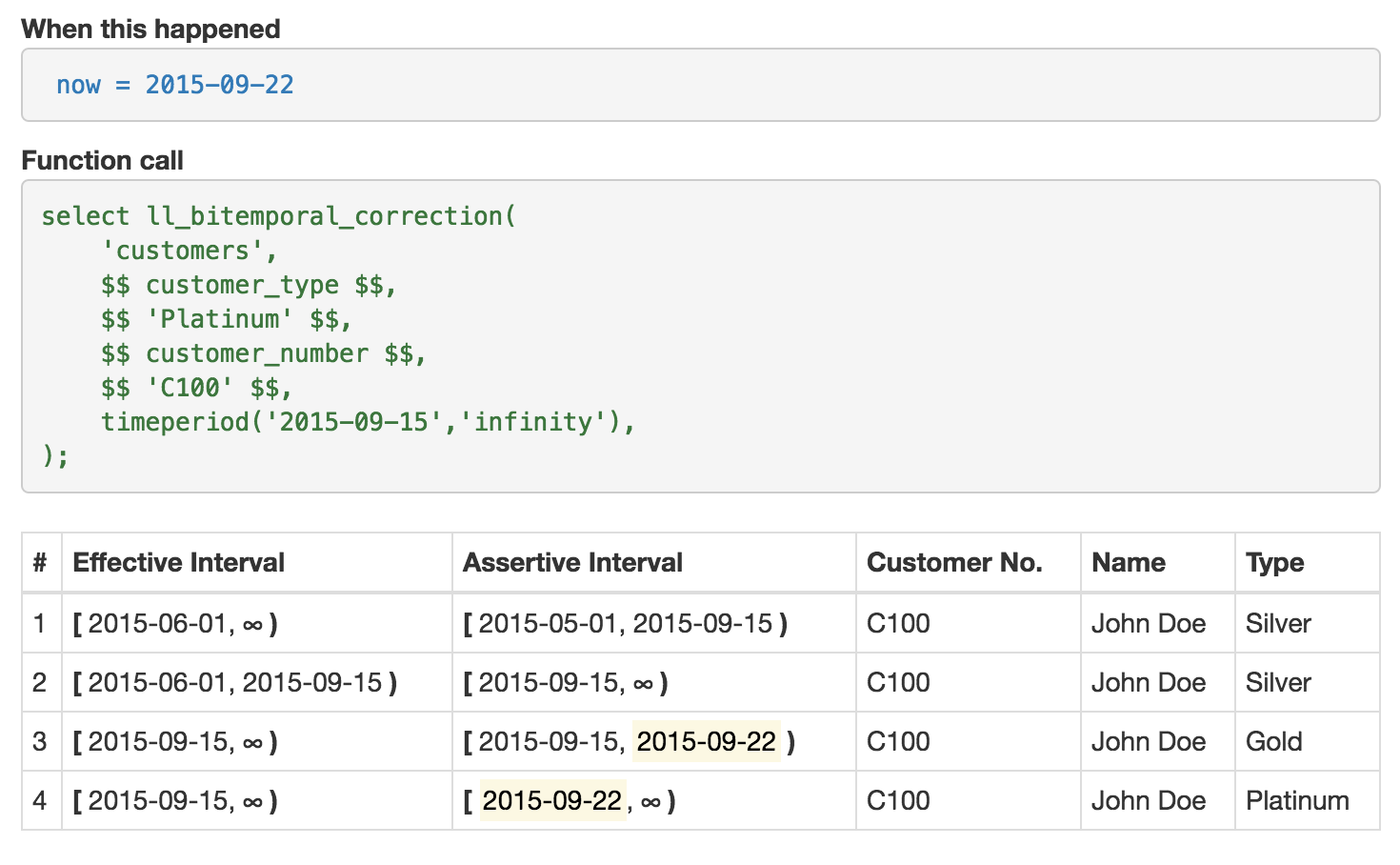
Bitemporal correction#
Effective
 Effective
Asserted
Asserted 1 1 3 2 3 2 4
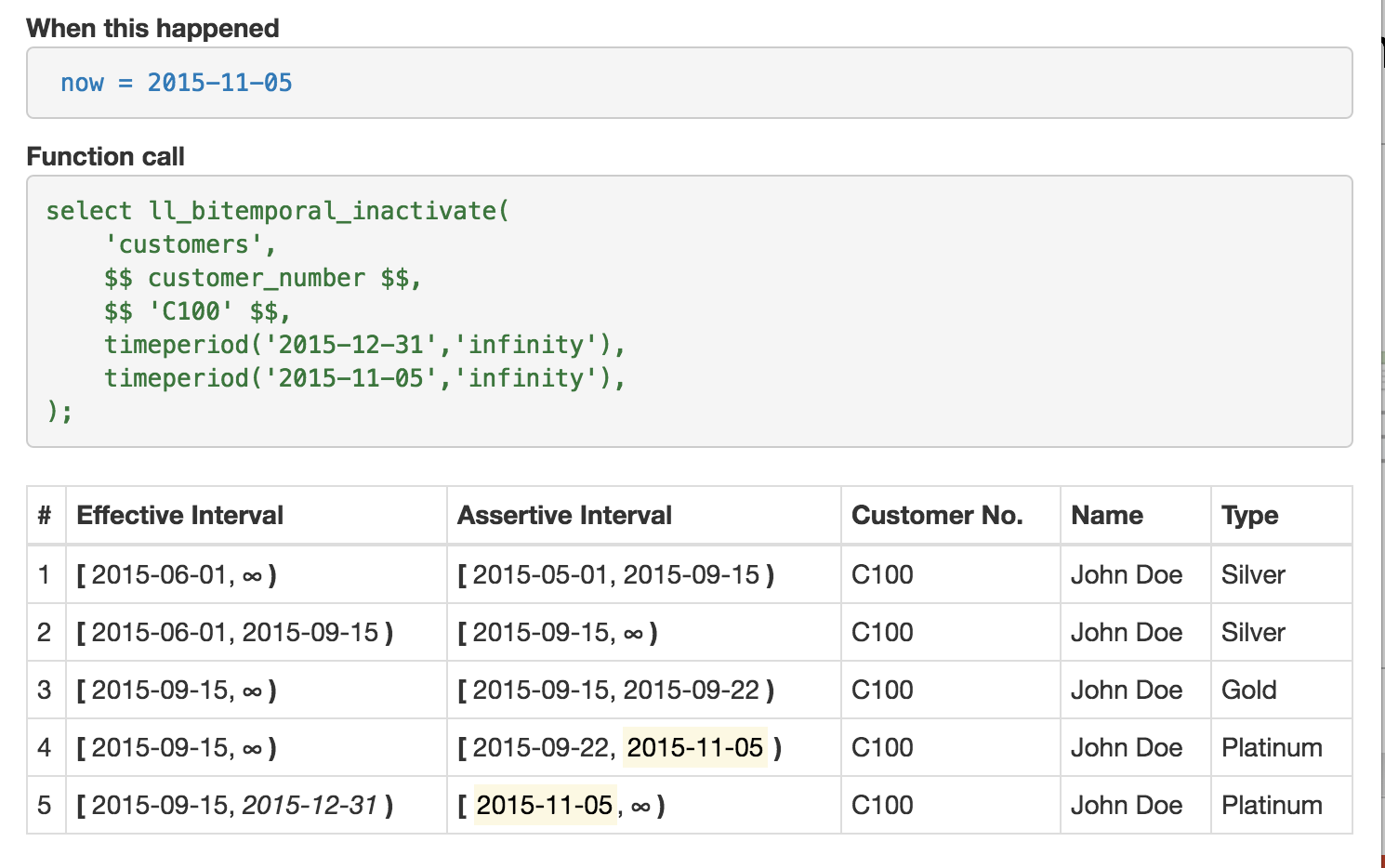
Bitemporal inactivate#
 Effective
Asserted
Asserted
1 1 3 2 3 2 4 4 5
Bitemporal delete#
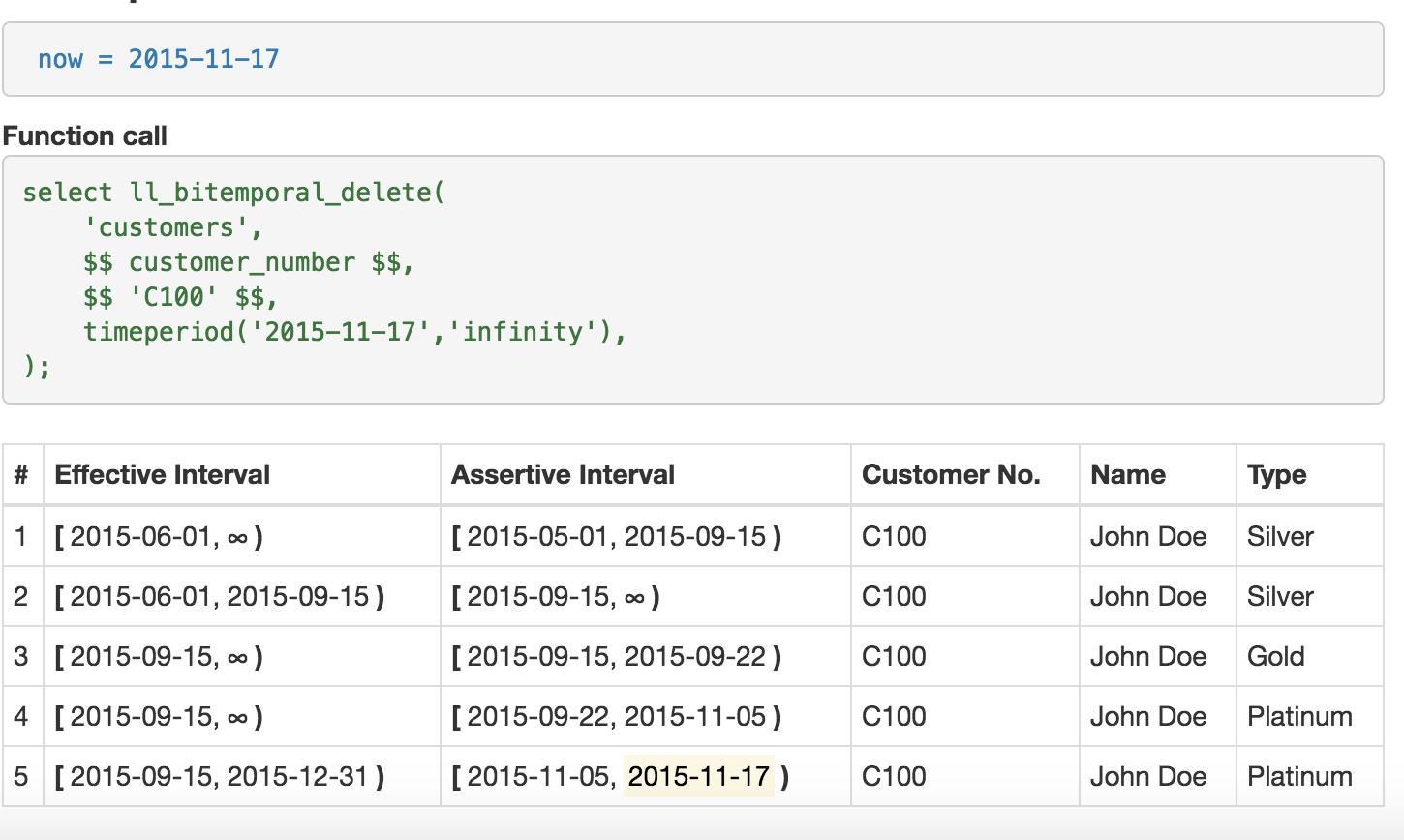 Effective
Asserted
Asserted
1 1 3 2 3 2 4 4 5
5
Repo:#
https://github.com/scalegenius/pg_bitemporal
How to define constraints#
We need to support the following constraint types: Primary key Unique Check – no difference from regular tables IS/IS NOT NULL – no difference from regular tables Foreign key We use metacode to record the presence of the bitemporal constraints?
What we’ve done with constraints so far#
PK: select bitemporal_internal.pk_constraint(‘postgres_cluster_id’); UQ: select bitemporal_internal.unique_constraint(‘port’); FK: why is it especially difficult?
Define foreign key constraint (bi-temporal referential integrity)#
The difficulty of verifying the bi-temporal FK is that the PK/UQ in the parent table should be effective and asserted all the time when a dependent record is effective/asserted CONSTRAINT “bitemporal fk postgres_version_database_versionsrelease_version” check (true or ‘fk’ <> ‘@postgres_version -> database_versions(release_version)@’));
Function: select bitemporal_internal.fk_constraint( ‘postgres_version’ ,’database_versions’ ,’release_version’);
FK constraint validation internals#
What happens, when a new FK is being created:
bitemporal_internal.ll_add_fk( p_schema_name text, p_table_name text, p_column_name text, p_source_schema_name text, p_source_table_name text, p_source_column_name text) returns text
FK creation steps#
Check whether the referencing field is a PK/UQ validate_bitemporal_pk_uq Create check constraint fk_constraint Check whether the validation on the parent table field already exists ll_lookup_validation_function If not, create it ll_generate_fk_validate create trigger on insert/update and a trigger function
Start of new material#
The previous slide was the last slide of the “review”. The next 11-15 slides should describe a new approach and algorithm
Understanding Bi-Temopral Queries#
Time Dimensions in Query Results#
Snapshot queries X=10 at a point in 2-D time TRUE or FALSE at any time Interval queries in selection criteria What is the value of X in a 2-D time region? May return multiple rows with time regions One-dimensional conditions are allso here Implicit time conditions Temporal join: R.a=S.a Values are equal only at time when they are valid in both R and S
Specifying Query Elements#
Conceptually each row has associated 2-D time region The strategy is to perform an operation as in non-temporal DB and calculate region for each tuple of result Operations on time regions: ∩ - intersection ∪ - union ∖ difference Examples: Interval query: intersect query region with tuple regions Join: find mathcing tuples and intersect their regions
Updates are Tricky#
UPDATE a_table SET attr = (expr) WHERE (cond) Time regions for: S – the UPDATE statement (for new values to be set) P -a row with old values (to be updated) N- a rwo with new valuses (empty of not exists) P ⋂ N = ⍉ After UPDATE the DB wil contain regions: Old values: P ∖ S New values: N ∪S
Time Regions#
Operations on time regions: ∩ - intersection ∪ - union ∖ difference Asserted inerval × Effective interval = rectangle Unfortunately, union and difference are of rectengles are not rectangular Sets of non-intersecting rectangles: all operationas produce sets or rectangles
Conceptual Representation:#
Nested Relational Each row contains a cuboid set DB primar key is the entire non-temporal row (business key, non-key attributes) DB foreign keys are unsuable Updates affect at most 3 rows
(business) key |
Non-key attributes |
Cuboid |
|
|---|---|---|---|
dim1 |
dim2 |
||
Alice |
10 |
1,10 |
1,100 |
Alice |
15 |
10,20 |
1,100 |
Bob |
9 |
1,5 |
1,30 |
5,10 |
50,100 |
||
Bob |
16 |
10,20 |
30,100 |
Current PG Implementation:#
Flat Relational DB primary key ( busines key, rectangle) PK uniqueness can be supported with indexes DB foreign keys are unusable Updates amost always affect several rows
(business) key |
Non-key attributes |
Cuboid |
|
|---|---|---|---|
dim1 |
dim2 |
||
Alice |
10 |
1,10 |
1,100 |
Alice |
15 |
10,20 |
1,100 |
Bob |
9 |
1,5 |
1,30 |
Bob |
9 |
5,10 |
50,100 |
Bob |
16 |
10,20 |
30,100 |
What we found during implementation#
The next six slides are from the last year presentation. I am leaving them for now, but they all should be replaced with the new ones, highlighting the new approach. I will try to add more later.